
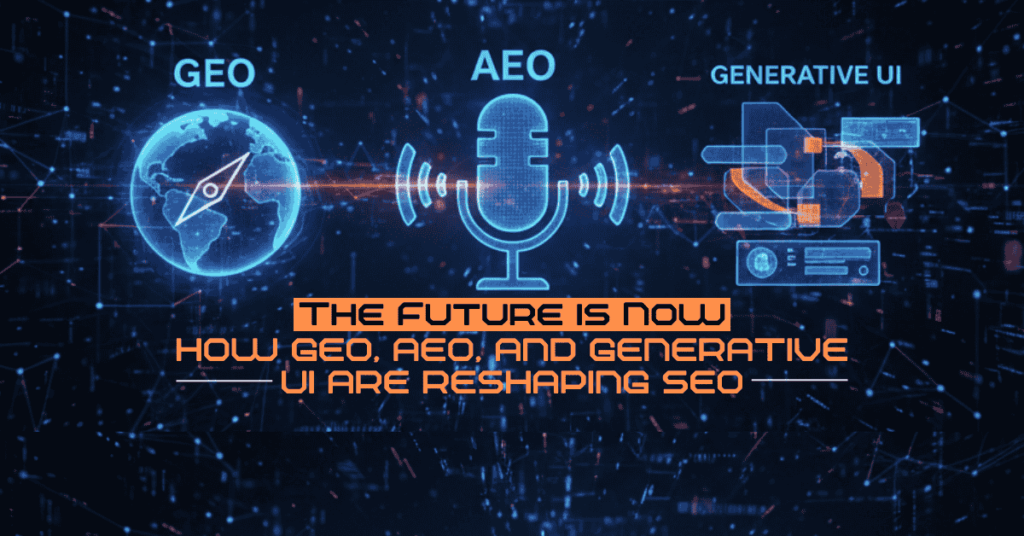
Most businesses are still optimising for a version of search that no longer exists. They are chasing keyword rankings on a results page that fewer and fewer people actually see, because the answer has already appeared before they get there.
Search has not just evolved. The rules have changed entirely. And the brands that understood this early are not just ranking higher. They are the ones being recommended, cited, and trusted by AI systems that now sit between the user and the web.
We work with businesses across Pune and beyond who are beginning to feel this gap. Their traffic is flat, their visibility is shrinking, and their competitors seem to be showing up in places they cannot explain. The explanation, almost always, comes down to three things. GEO, AEO, and Generative UI.
GEO Goes Deeper Than Near Me
Local SEO used to mean ranking for “dentist in Pune” or “digital marketing agency Pune.” That was enough when Google’s job was to return a list. But AI powered search does not return a list. It returns a recommendation. And that recommendation is built on a far more detailed understanding of context.
Geographic Engine Optimisation, or GEO, is the discipline of making your brand legible to these context aware systems. Instead of just associating your business with a city name, GEO signals help AI tools understand what you offer, where you operate, who you serve, and at what moments your service is most relevant.
The difference in practice is significant. A search today might look like “24/7 emergency dental clinic in Baner accepting insurance” or “digital marketing agency near Hinjewadi for early stage startups.” These are not broad queries. They are decisions already in motion. A business that has invested in GEO shows up in those moments. One that has only done traditional local SEO likely does not.
As marketing strategist David Meerman Scott has noted, “The internet has made it possible for smaller businesses to compete with bigger ones, but only if they understand the context in which their customers are searching.” GEO is that context, made actionable.
What a well-executed GEO strategy achieves is not more traffic in the abstract sense. It is the right traffic, at the right moment, from people who are already close to a decision.
AEO Puts Your Brand Inside the Answer
There is a meaningful difference between ranking on a results page and being the answer that an AI system delivers. The first requires someone to click. The second requires no further action. Your brand is already the recommendation.
Answer Engine Optimisation is the practice of structuring your content so that AI tools like ChatGPT, Google’s AI Overviews, Gemini, and voice assistants can extract, trust, and repeat your expertise. It is not about gaming these platforms. It is about writing with enough clarity, authority, and structure that the system has no reason to look elsewhere.
Research from BrightEdge found that AI Overviews now appear in more than 30% of Google searches, and that figure is growing. For queries with clear informational or commercial intent, the AI answer often receives the majority of attention. The links below it are secondary. This is not a future projection. It is the current behaviour of hundreds of millions of searches every day.
AEO optimised content addresses real questions directly. It uses schema markup so that search systems can understand not just what the words say, but what they mean. It builds what Google itself calls E-E-A-T, which stands for experience, expertise, authoritativeness, and trustworthiness. These are the four signals that AI powered systems use to decide whether a source is worth quoting.
When someone asks an AI assistant which digital marketing agency they should consider, or which local clinic has the best reputation for a specific procedure, the answer it gives was not randomly selected. It came from a brand that had done the work to be trusted. AEO is that work.
Generative UI Closes the Gap Between Interest and Action
Getting found and being trusted are two parts of the equation. The third, and the one most commonly neglected, is what happens when someone actually arrives at your website.
Generative UI replaces the static, uniform website with an experience that adapts to each visitor. The content, layout, offers, and calls to action shift based on who is viewing the page, how they found it, what they have done before, and what device they are using.
This matters more now than it ever did, because the user arriving from an AI recommendation has a different level of intent than one who found you through a generic keyword search. They have already been told your brand is worth their time. A website that greets them with a generic homepage undoes that trust in seconds.
In practice, Generative UI means a returning user sees the services they were most engaged with on their last visit. A parent who searched for child health services sees relevant offers without having to dig. A first time visitor on mobile gets a simplified, low friction path to contact or purchase. A user with dark mode enabled gets a visually comfortable experience rather than an interface that feels built for someone else entirely.
Jeff Bezos once said, “We see our customers as invited guests to a party, and we are the hosts. It is our job every day to make every important aspect of the customer experience a little bit better.” Generative UI is what that philosophy looks like in practice on a modern website.
The conversion impact is direct. When the experience feels relevant, friction drops, time on site increases, and the distance between arrival and action shortens considerably.
Why These Three Cannot Be Separated
Each of these strategies solves a distinct problem, but none of them is sufficient on its own. GEO brings the right person to your brand. AEO earns their trust before they even arrive. Generative UI turns that trust into a decision.
Treat them as a chain rather than a checklist. A brand that invests heavily in GEO and AEO but sends users to a static, generic website has done the hard work of earning attention and then wasted it. A brand that builds a beautifully adaptive website but has no presence in AI search results will simply never reach the users who now start their journey with a question rather than a search bar.
The brands dominating their categories right now are not winning on any single front. They are building systems where discovery, authority, and experience reinforce each other at every touchpoint.
SEO Has Always Been About Trust. Now the Systems That Grant It Have Changed.
This is ultimately not a technical shift. It is a values shift. For years, SEO rewarded those who understood the mechanics of an algorithm. What it rewards now is something harder to manufacture. Genuine authority, clear communication, and a website that actually serves the person using it.
That does not make the work harder. It makes it more durable. A business that has invested in being genuinely useful to its audience, locally relevant, clearly expert, and easy to engage with, is not dependent on the next algorithm update. It is building the kind of reputation that AI systems are specifically designed to surface.
The businesses that are quietly disappearing from search right now are not losing because of anything they did wrong in a technical sense. They are losing because the definition of visible has changed, and their strategy has not.
How Star Media Brands Can Help
We work with local businesses, clinics, hotels, shops, service companies, startups, and growing brands that want to be found where modern customers search, ask questions, and make decisions.
Our work covers GEO optimisation for precise local visibility, AEO content and structured data strategies that get brands cited by AI tools, and Generative UI website experiences that convert the intent rich traffic these strategies generate.
If your brand is ready to be found in AI search, trusted before the first click, and experienced in a way that converts, the time to build that foundation is now.
FAQ's
GEO helps AI powered search systems understand your business based on specific neighbourhoods, real time intent, and behavioural signals, going well beyond the broad city level keywords that traditional local SEO targets. The result is visibility in precise, high intent queries that older approaches simply cannot reach.
AEO structures your content so that tools like ChatGPT, Google AI Overviews, and Gemini can identify your brand as a credible and authoritative source worth recommending. It works through question based content, schema markup, and the trust signals these systems rely on when selecting which brands to surface.
Rather than showing every visitor the same static page, a Generative UI website adapts its content, layout, and offers based on each person’s behaviour, device, and intent. This personalisation reduces friction and directly improves both engagement and conversion rates.
Smaller businesses often benefit the most, since GEO helps them dominate neighbourhood level searches that larger competitors overlook, AEO builds authority in specific niches, and Generative UI delivers personalised experiences that big brands with legacy infrastructure struggle to replicate.
Most businesses begin to see measurable visibility improvements in AI search within three to six months, with authority and recommendation frequency growing steadily from there. Unlike paid campaigns, these results build on themselves over time rather than stopping when the budget runs out.