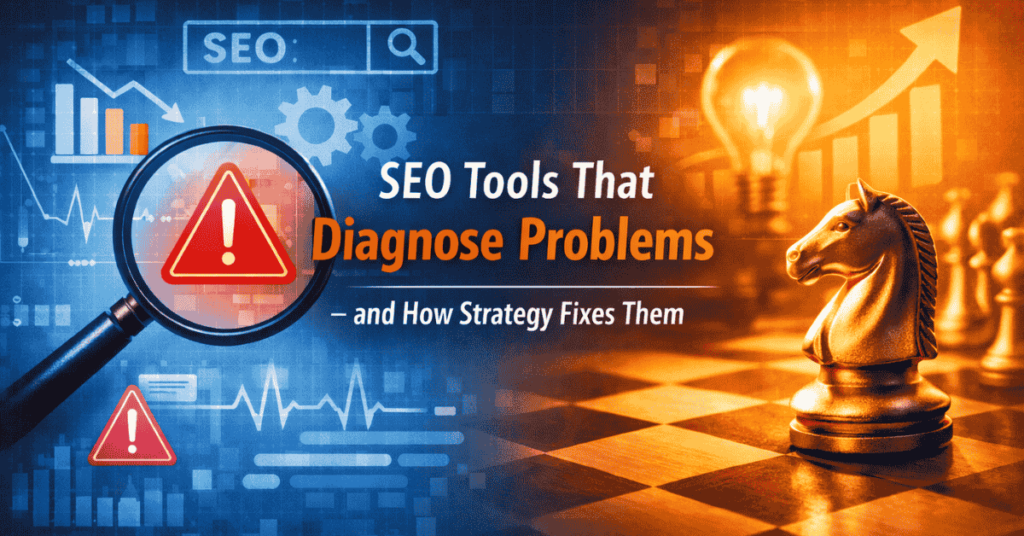
Most businesses struggling with organic search already have access to several SEO tools. Google Search Console highlights indexing issues, Semrush tracks rankings, and Screaming Frog uncovers technical problems. The data is available. The errors are visible. Yet rankings often fail to recover.
The reason is simple. SEO tools can identify problems, but they cannot determine which issues matter most, what should be fixed first, or how those fixes support broader business goals.
What SEO Tools Actually Do Well
Modern SEO tools are excellent at diagnosing website issues.
- Google Search Console provides direct insights from Google, including indexing errors, Core Web Vitals issues, and crawl anomalies.
- Screaming Frog crawls websites to identify broken links, duplicate content, redirect chains, and missing metadata.
- Semrush and Ahrefs help uncover keyword opportunities, backlink gaps, and competitive weaknesses.
- Google Analytics 4 reveals how users interact with your site and whether traffic is converting into meaningful engagement.
- Microsoft Clarity and Hotjar provide heatmaps and session recordings that highlight user friction and conversion barriers.
As Marcus Sheridan famously said, “Data does not make decisions. People do.” Every SEO tool generates data. None generates strategy.
From Diagnosis to Decision: A Real-World Scenario
Consider a mid-sized B2B services company that had been investing consistently in content production for eighteen months. Rankings were modest but stable — until they were not. Over six weeks, organic sessions fell by 38 percent. Search Console flagged a spike in crawl errors. Screaming Frog identified a cascade of redirect chains created when the site migrated to a new URL structure. Ahrefs showed that several high-authority backlinks were now pointing to redirected URLs that were not passing full link equity.
Every tool did exactly what it was supposed to do. The problems were identified clearly and accurately. What the tools could not provide was the answer to the more important question: in what order should these issues be fixed, and which one was actually responsible for the ranking loss?
The technical SEO audit confirmed the redirect issue was a contributing factor, but the deeper cause was an internal linking structure that had fragmented topical authority across too many shallow pages. The redirect fix was straightforward. The internal linking strategy took six weeks of deliberate restructuring, consolidating thin pages into authoritative pillar content and rebuilding the site’s topical clusters from the ground up.
Three months after the strategic work was completed — not after the redirects were fixed, but after the structural SEO strategy was implemented — the site recovered to its previous organic baseline and exceeded it by 22 percent. The tools identified what was broken. The strategy determined what actually needed to change.
Problem → Tool → Strategic Fix
Problem | Tool | Strategic Fix |
Pages not being indexed | Google Search Console | Improve crawl efficiency and remove duplicate or low value pages |
Sudden traffic decline | GA4 + Search Console | Identify affected content and align it with current search intent |
Broken links and redirects | Screaming Frog | Rebuild internal linking and restore link equity flow |
Competitors outranking key pages | Semrush or Ahrefs | Improve content depth, topical authority, and relevant backlinks |
Poor engagement on landing pages | Clarity or Hotjar | Improve page structure and answer user intent faster |
Weak authority growth | Ahrefs | Focus on earning high quality editorial links and industry mentions |
Where the Gap Opens Up
The limitation of SEO tools is not accuracy. The limitation is context.
A tool may show a ranking drop, a crawl issue, or declining engagement. What it cannot tell you is which issue deserves immediate attention and which can wait.
For example, a redirect loop affecting a high converting landing page may have a much greater business impact than dozens of missing image alt tags. Yet most dashboards present both issues with similar urgency.
Tools also cannot determine whether a keyword is valuable to your business, whether content matches buyer intent, or whether ranking improvements will lead to meaningful revenue growth.
Authority presents another challenge. Tools can measure metrics such as Domain Rating or backlink volume, but they cannot build trust, expertise, or industry credibility. Those outcomes come from strategy and consistent execution.
Why SEO Tools Matter in the AI Search Era
The arrival of AI Overviews and generative search experiences has not made SEO tools less relevant. It has changed what those tools need to measure and raised the stakes for getting the strategic interpretation right.
When a search query returns an AI-generated summary at the top of the results page, the click-through dynamics for organic listings below it shift significantly. Pages that previously captured traffic by ranking in positions three through seven now compete in an environment where a significant portion of informational queries are answered without a click at all. This makes traditional rank tracking a less complete picture of actual search visibility than it once was.
What it elevates, in turn, is brand authority and entity recognition. Google’s AI systems draw from sources they already trust publishers and businesses with established editorial credibility, consistent topical expertise, and a clear entity footprint across the web. A business that has invested in building genuine authority is more likely to be cited within AI-generated responses, even when its page does not appear in the traditional blue-link results.
This is where SEO tools and strategic judgment become inseparable in a way they have never quite been before. Tools like Search Console and Ahrefs can tell you whether a page is indexed, how many backlinks it holds, and where it ranks for a given term. They cannot tell you whether your brand is recognised as an authoritative entity in your topic area or whether your content strategy is building the kind of cross-channel trust signals that AI search systems weight heavily.
Entity-based SEO, where businesses optimise not just individual pages but their overall knowledge graph presence structured data, brand mentions across authoritative sources, consistent NAP signals, and topical depth is increasingly the layer that determines visibility in AI-influenced search. Structured data tools and entity validators exist to support this work, but the decisions about which entities to build authority around and how to do it coherently across a site require a strategy that no crawl report will produce on its own.
As Neil Patel has consistently argued, the businesses that win in modern search are those that think about SEO as a brand-building channel rather than a ranking channel. In a generative search environment, that argument becomes even harder to dismiss. The tools are necessary infrastructure. The strategy is what determines whether that infrastructure builds anything that lasts.
The Strategic Layer That Changes Outcomes
SEO growth happens when data is filtered through experience and judgment.
A strong SEO strategy prioritises issues based on business impact rather than dashboard alerts. It connects technical improvements, content decisions, and authority building into a coordinated plan.
A traffic decline might be caused by technical issues, weak content, poor search intent alignment, or declining brand visibility. Tools can highlight symptoms. Strategy identifies causes.
This is why businesses using the same SEO tools often achieve very different results.
What a Proper SEO Audit Covers
A professional SEO audit is far more than a list of technical errors. It evaluates:
- Crawlability and indexation
- Site architecture and internal linking
- Page speed and Core Web Vitals
- Content quality and search intent alignment
- Backlink quality and authority signals
- Competitor positioning
- Structured data implementation
- EEAT factors such as expertise, authority, and trustworthiness
The goal is not simply to find issues. The goal is to determine which improvements will produce the greatest business impact.
Why Strategy Matters More Than SEO Tools
The businesses that outperform competitors in search rarely have access to better tools. Most use the same platforms, including Search Console, Semrush, Ahrefs, and Screaming Frog.
The difference lies in how they interpret the data, prioritise opportunities, and connect SEO decisions to business goals.
As search evolves and AI driven experiences become more common, that strategic advantage becomes even more important.
Tools diagnose. Strategy delivers growth.
FAQs: SEO Tools & Business Growth
SEO tools help identify issues, but rankings improve only with strategy, optimization, and execution.
Because tools don’t fix trust, authority, and technical gaps on their own.
No. AI helps analyze data faster, but expert decision-making is still essential.
SEO tools should be monitored continuously, especially after Google updates or traffic drops.
If rankings fall, leads slow down, or technical errors persist, professional SEO support is needed.