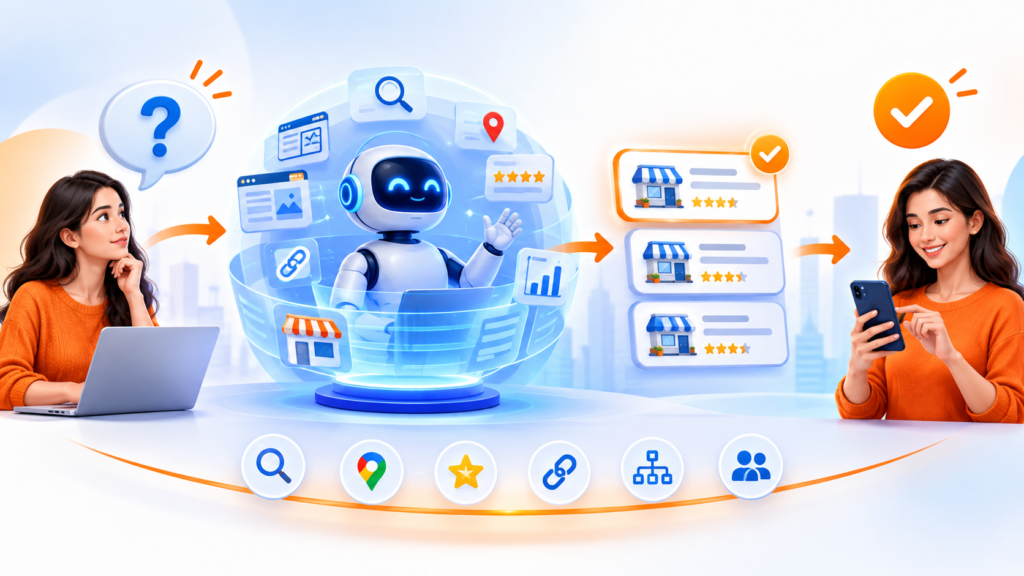
A customer used to type “digital marketing agency in Pune” and open five tabs. Today, that same customer can ask an AI assistant to find, compare and shortlist agencies for them. The assistant does the research. The customer sees the result.
This is the shift AI agents are bringing to search. It affects how people find businesses, and it changes what good SEO looks like. This guide explains what is changing, why it matters, and what your business can do about it.
What Are AI Agents in Search?
AI agents are systems that understand a goal and work toward it. In search, they do more than list links. They read multiple sources, compare options, answer follow-up questions and suggest a next step.
Here is the difference in practice.
- Old search: “digital marketing agency in Pune”
- AI-powered search: “Find a reliable SEO agency in Pune that can improve my Google visibility and my visibility in AI search.”
The second query carries much more context. It names a location, a service, a goal and a quality standard (“reliable”). An AI agent uses all of that to decide which businesses to recommend.
Why this matters: the agent can only recommend what it can understand. If your website is vague, the agent has little to work with. Your competitor’s clearer website wins the mention.
How AI Agents Are Changing the Customer Search Journey
The old journey was simple. A person searched, visited a few websites, compared them and made contact.
The new journey adds a research layer before your website is ever opened.
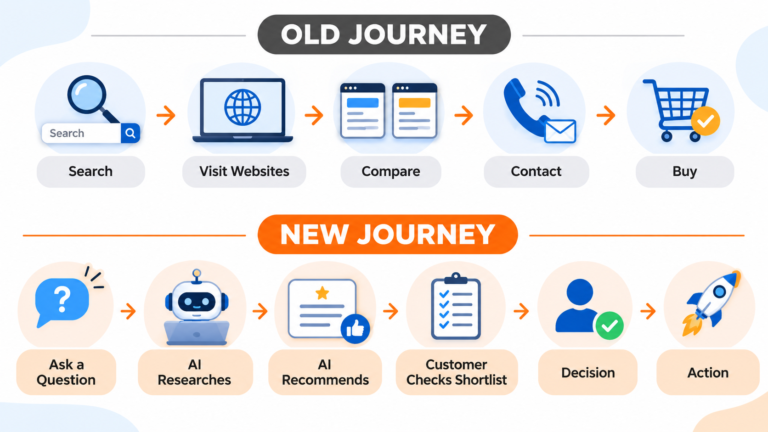
| Stage | Traditional Search | AI-Powered Search |
|---|---|---|
| Query | Short keywords | Long, specific questions |
| Research | Customer opens many pages | AI gathers and summarizes sources |
| Comparison | Done manually | Done by the AI agent |
| First Impression | Your page title and snippet | How the AI describes your business |
| Visit to Website | Early in the journey | Often later, when trust is already built |
A practical example: a customer asks, “Which SEO agencies in Pune handle local SEO and Google Business Profile?” The AI may list three agencies. Your business can appear only if the AI finds clear, consistent information about your services and location.
This makes visibility bigger than a ranking position. You need to be understood, not just indexed.
How AI Agents Affect SEO
The biggest change is the move from keyword matching to intent matching.
Consider this query: “What is the best digital marketing strategy for a healthcare clinic in Pune that wants more local visibility?”
To answer it, an AI system must grasp four things:
- the business type (healthcare clinic)
- the location (Pune)
- the goal (local visibility)
- the service needed (digital marketing strategy)
A page that repeats “digital marketing Pune” ten times does not help here. A page that explains how clinics attract nearby patients, with examples, does.
Keywords still matter. They signal relevance. But they now work best when supported by context, clear structure and real answers.
What still works, and why
Traditional SEO remains the foundation. Here is why each part still matters:
- Technical SEO and crawlability. If systems cannot access your pages, nothing else counts.
- Helpful, original content. AI systems draw from pages that add something new.
- Structured data. It labels your content so machines read it correctly.
- Internal linking. It shows how your topics connect.
- Local SEO and Google Business Profile. They confirm where you operate and who you serve.
- Mentions and reviews. They show that others trust you.
Why AI Visibility Is Becoming Important for SEO
AI visibility is how easily AI-powered search can find, understand and accurately describe your business.
Compare two clinics in the same city.
- Clinic A has detailed service pages, the same address and phone number everywhere, recent reviews and mentions on local health sites.
- Clinic B has a thin website. Its name is spelled three ways across directories, and its services are unclear.
When an AI agent answers “best physiotherapy clinic near me for back pain,” it has plenty of reliable facts about Clinic A. It has conflicting facts about Clinic B. The agent will favor the one it can describe with confidence.
Why this is an SEO issue: the signals that build AI visibility are the same ones that build search authority. Clarity, consistency and trust serve both.
Ask yourself these questions:
- Can a stranger tell what we do within ten seconds of reading our homepage?
- Are our name, address, phone and services identical across the web?
- Do our pages answer the questions customers ask us on calls?
- Do trusted websites mention us?
If you answer “no” to any of them, you have found a gap.
What Is Agentic SEO?
Agentic SEO is an emerging approach. It prepares your digital presence for AI agents that gather information, compare options and help users complete tasks.
Traditional SEO helps search engines find and rank pages. Agentic SEO also helps AI systems use your information to answer, compare and recommend.
In practice, that means making these details easy to find and easy to trust:
- products and services
- locations and service areas
- pricing or price ranges, where suitable
- expertise and experience
- answers to common questions
- contact details
- reviews and reputation
Agentic SEO is still developing. Treat it as a direction, not a fixed rulebook.
How SEO Agencies Can Help Businesses Prepare for AI Agents
An SEO agency with real experience can connect classic SEO with AI search work. The table shows what that looks like and why each task matters.
| Area | What the Agency Does | Why It Matters |
|---|---|---|
| Technical SEO | Fixes crawl, speed and indexing issues | AI and search systems need access to your content |
| Search Intent Research | Maps the real questions customers ask | Content then matches how people actually search |
| Content Optimization | Builds clear, expert, well-structured pages | Clear pages are easier to quote and trust |
| Entity and Brand Consistency | Aligns name, services and locations across platforms | Consistent facts reduce AI errors about you |
| Local SEO | Improves Google Business Profile, citations and local pages | Location-based queries are common in AI search |
| AEO and GEO | Formats answers for answer engines and generative search | Short, direct answers are easier to surface |
| AI Visibility Tracking | Checks how AI tools describe your business | You find gaps before customers do |
How an SEO Agency Can Improve AI Visibility
Improving AI visibility does not mean adding the word “AI” to every page. It means strengthening your overall presence. A good agency usually works on these areas:
- Clear site structure. Group services, locations and FAQs logically so machines and people can follow them.
- Useful content. Answer the questions buyers ask before they commit.
- Topical authority. Publish connected articles on your core subject instead of random posts.
- Consistent business information. Match details across your site, profiles and directories.
- Local optimization. Keep your Google Business Profile complete and active.
- Internal links. Link related pages so topic relationships are obvious.
- Structured data. Mark up services, organizations, FAQs and reviews where relevant.
- Reputation building. Earn genuine reviews, mentions and links.
Where Human Judgment Still Matters
AI tools now help with almost every digital task, from keyword clustering to drafting content. Recruitment is a useful comparison, because it has gone through the same change.
Many recruitment teams use AI to screen résumés, rank candidates and schedule interviews. The speed gain is real. But the tool can only match patterns. It cannot judge whether a candidate will handle pressure, fit a team or grow into a role. Experienced recruiters make those calls. They also catch cases where an automated filter rejects a strong candidate whose résumé looks unusual.
SEO works the same way.
- An AI tool can suggest 200 keywords. A strategist decides which ones match real business goals.
- An AI tool can draft a page. An expert checks that the facts are right and the advice is honest.
- An AI tool can flag a traffic drop. A specialist works out whether it is seasonal, technical or a sign of a deeper problem.
Why this matters for your business: AI speeds up the work, but accountability stays with people. Content that carries real experience, original examples and accurate claims is also the content AI systems are more likely to trust and reuse. Be cautious of any agency that promises results from automation alone.
A recruitment-agency example: a staffing firm wants to be found when employers ask AI tools, “Which agency can fill senior engineering roles in Pune?” It publishes pages on its hiring process, industries served and placement approach, written by its own recruiters. It keeps its Google Business Profile current and collects client reviews. Its human expertise becomes the signal AI systems pick up.
The Future of SEO: From Rankings to Digital Visibility
The future of SEO is not a swap of rankings for AI. Search is becoming a wider ecosystem, and customers may meet your brand in many places:
- traditional Google Search
- Google AI Overviews and AI Mode
- other AI-powered search and answer engines
- local search and maps
- business directories and review sites
- industry websites and social platforms
The goal shifts from “rank first” to “be found, understood and trusted wherever customers look.”
How Businesses Can Prepare for AI-Powered Search
You do not need to rebuild your strategy overnight. Strengthen the basics first, then extend.
- Audit your current SEO. You cannot fix what you have not measured.
- Fix technical issues. Crawl and speed problems block everything else.
- Write for customer questions. Use the real questions your sales team hears.
- Build strong service and location pages. Each should say who you serve and where.
- Optimize your Google Business Profile. It is a key trust signal for local search.
- Link related pages. This helps systems see your topic coverage.
- Align your brand details everywhere. Consistency lowers the chance of wrong answers about you.
- Build topical authority. Depth on one subject beats shallow coverage of many.
- Add AEO and GEO practices. Give short, direct answers near the top of key pages.
- Test your AI visibility. Ask AI tools the questions your customers ask, and record what they say about you.
How Star Media Brands Can Help
At Star Media Brands, we help businesses improve their visibility through SEO, Local SEO, AI search optimization, AEO, GEO and digital marketing. We also provide LLM visibility services, including business profile creation and optimization across different LLM and AI-powered tools, helping businesses build a stronger presence where customers are increasingly searching for recommendations and information. We start with proven SEO fundamentals and add AI search work where it creates real value.
Whether you want more organic traffic, stronger local visibility, better leads, improved LLM visibility, business presence across AI tools or a clearer presence in AI search, we can build a plan around your goals — and much more.
Conclusion
AI agents are changing how customers search, and that changes SEO. Rankings still matter. But clear information, real expertise and consistent signals now matter just as much.
Start with the fundamentals. Make your business easy to understand. Back your content with human experience. Then measure how both people and AI tools see you.
FAQs
AI agents are systems that understand a user’s goal and help complete it. They research, compare and recommend, instead of only listing links.
They raise the value of clear, useful and trustworthy information. Businesses must aim for visibility across AI-powered search, not only a ranking position.
Yes. Crawlability, quality content, structured data, internal links and local SEO are the base that AI search also depends on.
It is an emerging approach to making your business information easy for AI agents to understand, compare and use when helping customers.
Customers increasingly get recommendations from AI tools. If those tools cannot understand your business, they may not mention it, or may describe it wrongly.